Tuesday, December 19, 2017

What's Next on the Millennial Hit List?

Millennials have accumulated about half as many assets as the same age group had in 1989. They also make about $10,000 less on average. Young adults with debt and a degree today make about the same as young adults with no degree in 1989. That said, it's still much better to have a degree than not.
http://mashable.com/2017/07/31/things-millennials-have-killed/#iWtTsO10zZqT
For a reason unknown to the general public, there has been a steady stream of articles and studies done to prove how millennials are ruining one thing or another. There is a wide range of victims; millennials have killed everything from diamond to paper napkins to democracy, according to the above article. Do millennials have motives in the systematic elimination of once-successful industries? Or is simply that they can no longer afford the same luxuries as baby boomers, who created an economy in which millennials are destined to fail? No one but millennials can answer such questions, but according to the baby boomers writing these accusatory articles, they are too busy eating avocado toast and murdering fabric softener to care.
Why did baby boomers love diamonds so much in the first place? They were a symbol of wealth and status that only the richest could afford, and were even featured in a song by Marilyn Monroe, thus making them desired by all and purchased by all that could afford them. Millennials, on the other hand, have much more serious things to worry about in comparison to their social status or the stones they wear on their fingers; their predicament reflects the society created by the baby boomers that has made financial success and stability seem impossible even to the most anti-millennial mind. To be employed in a job which gives people enough money to cover all expenses as well as save enough to live a comfortable life all the way through retirement, prospective employees must have a solid education. To achieve this, they must go to college, a necessary task which baby boomers have made impossible for millennials as well. Older generations accuse millennials of being lazy because they are unable to pay these fees like they did back in the good ol' days. However, according to the New York Times, "In 1976, tuition and fees at private colleges were $10,000 in 2016 dollars. Now they’re $33,000. For public colleges there was a fourfold increase, from $2,500 to $10,000." These high fees have resulted in millennials becoming unable to afford unnecessary luxuries such as diamonds; the average student loan debt is $28,950. Once millennials land the jobs for which they worked so hard to earn, they must first pay off the mountain of crippling debt before even saving for the future, let alone buying precious stones. The image on the top left shows that millennials also earn a smaller average annual salary, thus hindering their ability to pay off their debt further and extending the amount of time in which they are consumed in debt. The second image shows that even with the degrees which are so necessary to get a high-paying job, millennials earn around the same amount as the average baby boomer did without earning a degree, which proves further that baby boomers have created a society surrounded around draining millennials of their resources, disabling them from ever supporting industries like those of diamonds and cruises.
Along with being burdened with crippling student loan debt, millennials also have to deal with a major problem created by baby boomers: climate change. By burning fossil fuels and cutting down trees at an unprecedented rate, baby boomers have killed the environment, which is unsurprisingly not an item on the list of things that have failed at the hands of millennials. This explains the millennials' killing of the paper napkin industry, as well as those of cars and oil. Left with a ruined environment and economy, they have been forced to rethink their priorities and save the world rather than the bar soap industry. Baby boomers will be long gone before they experience the extreme effects of climate change, giving them no reason to help millennials to prevent them from ever occurring. Why are millennials being portrayed as murderers rather than heroes of a ruined wold?
The media, which are for the most part still controlled by baby boomers' corporations, choose to depict millennials as lazy individuals who would rather post pictures of latte art and avocado toast than work as opposed to people left to clean up and repair the mess left by the baby boomers. This creates a negative image of millennials in the eyes of older generations, who are in reality spending their money on pointless things like cruises and diamonds rather than helping to save the world. What will millennials kill next? The bracelet industry? Tennis? The hope of ever being financially or environmentally stable? My prediction is the latter, though baby boomers are accomplices.

Sunday, December 17, 2017

How We Market Ourselves

Image result for fake people
This semester, I've become much more aware of the constant stream of advertisements to which I am exposed every day. This number high, considering how many types of social media to which I belong, each with their own type of advertising in an attempt to make me more interested in certain products. On YouTube, I see commercials; on Snapchat, I see advertisements in the form of pictures after watching others' stories; and on TV shows, I see products used with their brand clearly visible. None of this is new or surprising; though I did not know the extent to which advertisements influence my experiences on the media, I have yet to grasp how they affect how I act and speak to others.
Beyond simply being able to recognize a certain brand just by hearing a snippet of its jingle, my constant exposure to media has shaped the way people act around each other, as it has created a sort of a culture in which people advertise themselves even in the most casual of encounters. For example, whenever someone says something good that they've done, such as achieved a high grade on a test, others often feel practically obligated to tell of their own successes as well in order to promote themselves as if they were a product. In commercials, such as those produced by Sprint, story-lines often fall along those of comparing themselves to other brands in order to make their own product seem more desirable. This type of advertisement always shines a negative light on others and degrades their achievements for the sake of success. When someone feels the need to promote themselves at the expense of others' happiness and self-esteem, their motivations are based in an advertisement-like need to succeed and make themselves seem like the better "product," when in reality the success of one person does not make another less successful, at least in terms of test grades. Social media is another way of promoting and "advertising" ourselves; we only ever post what we feel is the best of us, showing us doing whatever we feel will make others either jealous or happy. By posting photos of ourselves in order to attract positive attention, we promote ourselves in the same way a brand would promote a product, using our ideas of beauty to make us seem more likable and desirable as a person.
Yet another way we promote ourselves is through how we carry ourselves and the persona we have created as a result of what we feel is acceptable in our society. For example, the clothes we wear promote not only the brand from which we purchased them, but ourselves as well. We are simply an accumulation of what we feel is acceptable in society, and our clothes are a direct representation of this. As humans, it is natural for us to judge someone simply by looking at them, and they clothes they wear are a natural point on which we based our uneducated judgement. They decide whether someone is acceptable to talk to, and if they are more successful than you in the ongoing competition to both fit in and stand out. This type of subtle marketing has, in part, created the stereotypes on which we base our judgment as well, as they decide whether or not the presence of the person who fits in a certain stereotype will make us more or less acceptable. Such stereotypes are racially based, and when someone decides whether or not to embrace the stereotype with which others associate them they are deciding subconsciously how they wish to market themselves. Our judgment based on such stereotypes is often harmless, but in some cases it can be deadly. For example, the personal advertisement-based judgment of a police officer is much more dangerous than my own, as seen in the seemingly weekly shootings of people of color at the hands of white cops.
The way we market ourselves to others is the physical representation of what we feel is good and acceptable in society. We learned the technique of promoting ourselves to others from the millions of advertisements to which we have been exposed in our lifetimes, and it is affecting our relationships with others.

Thursday, December 14, 2017

Why You Shouldn't Laugh at Mental Illness

Image result for the importance of trigger warnings
In the media, upsetting images, videos, and messages are uploaded daily. For people suffering from Post Traumatic Stress Disorder, anything from watching an episode of their favorite TV show on Netflix to scrolling through their feed on Instagram could remind them of their traumatic experience(s) and result in an emotional and physical reaction from the person suffering such a mental illness. According to the Huffington Post, "Triggers, images, sounds, smells and, yes, texts, that provoke specific emotional and physical responses in people, are not about 'squirming.' They are complex, unpredictable and highly individual reactions to material that evokes pain and fear." Basically, trigger warnings are used to prevent such painful reactions and create a safer, happier environment for everyone.
The image above is an example of warnings used in the media to tell viewers of potentially upsetting content, as Game of Thrones is a particularly violent show and thus more likely to remind someone of a traumatic experience. The same type of warnings area used in many other shows, including American Horror Story, with frequent violence and different types of assault featured frequently that could easily remind someone of such an occurrence, as violent encounters are not uncommon. According to the Nebraska Department of Veterans' Affairs, "An estimated 7.8 percent of Americans will experience PTSD at some point in their lives, with women (10.4%) twice as likely as men (5%) to develop PTSD. About 3.6 percent of U.S. adults aged 18 to 54 (5.2 million people) have PTSD during the course of a given year." Millions of Americans alone experience PTSD every year, meaning that each suffers the fear of even checking the news in case it may bring about a horrible memory that would evoke such a reaction that could be as strong as when the event originally occurred. To protect the mental stability of millions of Americans, trigger warnings should be implemented on a higher scale, overall creating a much safer environment.
Recently, all types of media have attacked the use of trigger warnings, accusing them of censoring media and allowing the next generation to become hypersensitive and humorless. According to a Huffington Post article contradictory to the article mentioned above, "If the truth might hurt someone’s feelings or cause discomfort, well then we need to cuddle them whilst in a communal fetal position." The article pokes fun at college students' request for such warnings, claiming that they prevent them from learning about potentially upsetting events. This is a common misconception about trigger warnings; their purpose is to protect mentally ill students from revisiting traumatic experiences, not to limit the learning of the entire student population. Warnings will not change what is taught; they will simply alert students of the material that is to be covered in case it could be dangerous. This misunderstanding of the purpose of warnings leads to heavy criticism, as many people claim that alerting people of potentially upsetting subject matter is limiting their own means of education. In reality, the only people affected by trigger warnings are those who need them, and all others who claim to be harmed or disadvantaged by them have a misunderstanding of both the meaning and usage of what a warning truly is. In many social media posts, people have humiliated people with mental disorders such as PTSD and OCD by claiming to be "triggered" about something while only being mildly upset or disagreeing with something. Again, this ignorance results from the gross misunderstanding of trigger warnings and the individuals with mental disorders for whom they are absolutely necessary in order to enjoy the media without the threat of a reaction hanging over them.

Tuesday, December 12, 2017

Conservatives: The Real Snowflakes

Related image
https://oncewrittensite.wordpress.com/2017/01/05/generation-snowflake/

       Since the election of Donald Trump, conservative media including websites, TV shows, and newspapers have attacked Democrats for feeling shocked and disappointed over the loss of their preferred candidates.  As seen in the link above, an anonymous author wrote an article titled "Generation Snowflake" describing the sensitivity and ignorance seen in millennials today and how such qualities spiked following the election.  The article had no evidence to back its claims and based its perception of millennials off their recent demands for "safe spaces" and trigger warnings, claiming that because they were not necessary before, they are not necessary now, and that the need for them is a result of the pampered childhoods of millennials.  However, they are necessary not because millennials are crybabies with no tolerance for opposing opinions, but because they have realized the destructively ignorant and insensitive natures of many people that have created a dangerous world for anyone other than a white, heterosexual, neurotypical, cisgender male.
       The above image depicts millenials as destructive crybabies in an attempt to draw support from other Republicans, but it fails to show how the reasons why they are crying are a result of oversensitivity; the back "baby" is holding a sign that says, "#hold your breath for justice," in reference to the peaceful protests happening all over the world, including the NFL.  Though it is meant to show how pointless peaceful protesting is, it indirectly references Mahatma Gandhi, who fasted to fight for India's independence from Britain in a nonviolent way of protesting the injustices he and his people experienced.  The photo poses the question: if people aren't supposed to protest nonviolently, how are they supposed to protest?  The answer from most conservatives is "not at all," as Americans should love America, but rather than promoting American values, this way of thinking violates the First Amendment of the Constitution which they work so hard to defend in order to keep their guns.  The baby uses a hashtag on its statement, which is supposed to represent how millennials are dependent on social media and technology in general, but it also shows how social media can be used to educate others about ways to protest peacefully and the injustices they are protesting.   The baby is supposed to make a statement of oversensitivity, but it instead represents conservatives' opinions on nonviolent protesting.
       The second baby holds a female sex symbol in reference to women's rights in order to demonstrate how women should apparently not be protesting to fight the injustices they face.  Again, the article pokes fun at protesters who simply want to stand up the rights rights they feel are being violated.  Many conservatives feel as if women are already treated equally to men and this have nothing to "complain" about, but in reality, the wage gap exists for all women and for women of color in particular, there are still thousands of rape cases with female victims annually, child marriages are still normalized in certain cultures, and many more cases of common injustices still to be fought.  This baby is supposed to represent the uselessness of women's rights protests, but it instead acts as a depiction of conservative ignorance.
       The first baby in line is a baby of color crushing more "sophisticated" and "mature" looking white people and is holding a rattle that says "racism" and a toy sword that reads "social justice."  This is most likely a reference to the "dangerous" nature of people of color that is so feared by white conservatives, who, like Donald Trump, claim to be the "least racist people" that exist, despite silencing movements such as Black Lives Matter because they fear of losing their white privilege.  If they are so protective of their "whiteness" and are afraid of losing the privilege that comes with it, aren't they the real "snowflakes?"  The rattle represents how millennials claim everything is racist and not being able to take a joke, when in reality, the joke is one told by Grandpa at Thanksgiving about horrifically ignorant racial stereotypes that has been politely ignored until millennials decided that it was too bad to bear.  Being unwilling to laugh at and accept racial stereotypes is far different from being too sensitive and unable to take a joke, though conservatives often get the two confused because they are the ones telling the racist jokes, and they are hurt that no one is laughing anymore.  The "social justice" sword is supposed to represent the stupidity and uselessness of the call for social justice, when in reality it is a movement to fight for people across all intersections and destroy the irrational, racist phobias that make up the internet.
     The picture above epitomizes the ignorant nature of conservatives in an attempt to be humorous, but only managing to perpetuate the sensitivity of such people.

Sunday, December 10, 2017

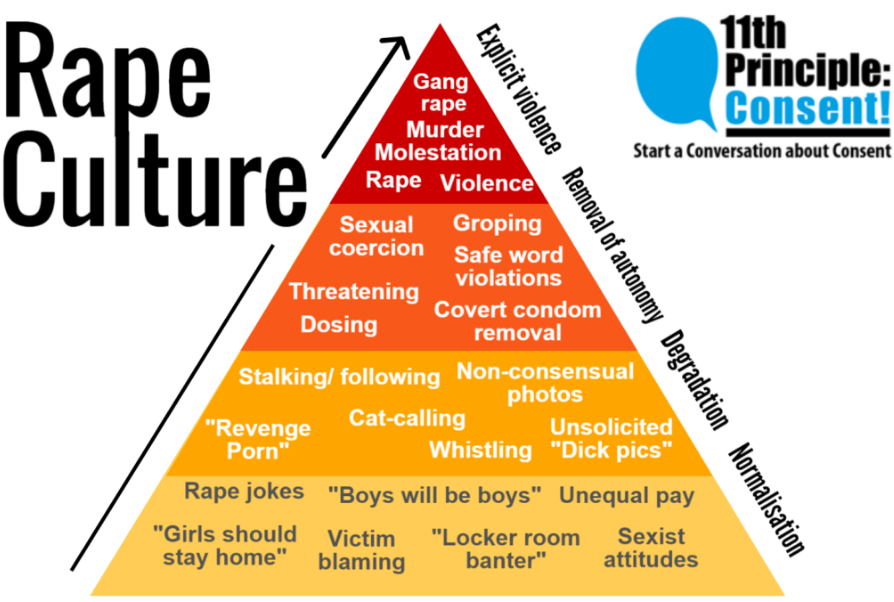
Rape Culture in the Media

Image result for rape culture pyramid
https://www.thedailybeast.com/sarah-huckabee-sanders-all-trump-accusers-are-lying
http://www.cnn.com/2017/12/10/politics/nikki-haley-donald-trump-accusers/index.html

       Recently, many men and women have come forward and told the public of their experiences of sexual assault, accusing powerful and important men of horrible crimes.  Many people and news outlets believe them and take their tales as reasons to progress as a society and challenge the rule of such powerful men.  However, on the opposite end of the spectrum, some people accuse the alleged victims of lying, defending the men and thus perpetuating rape culture.
       Rape culture is the subtle normalization and dismissal of sexual assault towards women, from saying "boys will be boys" as an excuse for offensive jokes or actions to blaming a victim for their own assault.  Though it's vulgar and inexcusable, many people deny its existence; because they themselves have not raped anyone or been assaulted, they feel that such a culture cannot possibly exist to any extent in society.  However, every single woman is affected negatively by its existence; though many of us have had no first-hand experience with sexual assault, why do we fear walking home alone at night?  Why do we go to bathrooms in groups?  Why are we expected to be docile and submissive, while men should be aggressive and ambitious?  It's because even from the start, from the day we were defined as "girls," rape culture has controlled our lives.  It is what makes a woman's skirt length and alcohol intake more punishable than a man's crimes.  Contrary to popular belief, rape culture negatively affects men as well; it puts pressure on them to be romantically and sexually involved early on in their lives; it dismisses their accusations of sexual assault because they are supposed to "want it" and be "strong" enough to fight back, even if they are intoxicated; and forces them to stay silent about their own physical and emotional abuse, because only "weak" men get abused.  However, it allows men to evade punishments for their sexual crimes only as a result of their gender, diminishing their assaults to lies or mistakes.  Rape culture is real and it is ruining the lives of billions.
       In the first article above, Sarah Huckabee Sanders, the White House Press Secretary, denies all claims against Donald Trump, arguing that all sixteen of his accusers are lying.  The fact that she, a woman, so blindly follows a man accused of such horrible crimes against other women, shows the prevalence of rape culture in media; she so easily dismisses sixteen people who claim to have been assaulted by Donald Trump, who has bragged about such things in the past, in order to protect his image.  This level of ignorance harms those who were brave enough to share their stories; rather than support, they face negativity and humiliation.
       In the second article, US ambassador Nikki Haley applauds women for having the strength and courage to share their stories to the world, knowing that they would face backlash from Trump's unconditional supporters.  In order to dismantle the rape culture that has been woven into our society, people must be comfortable coming forth with their stories of assault to society, knowing that they will be believed and supported.  It is also the duty of everyone else in society to listen to them and support them whether we know the alleged assaulter personally or not.  The media, which has perpetuated rape culture by allowing its unrealistic and harmful stereotypes into every aspect of the technologically-connected world, needs to dismantle its reliance on such stereotypes in order for the world's societies to progress.

Friday, December 8, 2017

"Skinny" kills


Image result for pretzel crisps skinny ad
       Often in advertising, companies will use provocative and sometimes controversial methods of attracting attention to their products.  Behind the seemingly thoughtless and insensitive material they publish, there is always at least one strategy to attempt to gain more customers.  For example, in the Pretzel Crisps advertisement pictured above, the company attempted to sell their product by promoting the taste of their product as well as perpetuating the harmful stereotypes that haunt societies all over the world today.
       The Pretzel Crisps advertisement appeals to readers' physiological need for food, with a picture of a pretzel accentuated at the top of it.  It is made more prominent by being more colorful and interesting than the basic font of the words below it.  By doing this, the company attracted attention to their advertisement because all humans have the need to eat, so by ways uncontrolled by us, we are automatically drawn to it, whether we read the captions or not.  Just by including a picture of their product, Pretzel Crisps installed a reminder in the back of each consumer's mind that they taste good and are a worthy candidate for purchase the next time they appear in the aisle of a grocery store.  However, the picture of the pretzels is not the only component of the advertisement with which the company intended to sell their product; though it may be more visually appealing, the caption beneath it is what will remain in the readers' minds.
       The pictured phases "You can never be too thin" and "Tastes as good as skinny feels" appeal to consumers' subconscious need for affiliation; though it does not explicitly say that being thin will make a person more popular or prettier, it does say that thin "feels" good.  Rather than promoting the healthiness of their chips or the simple ingredients of which they are composed, Pretzel Crisps instead plays on the idea lingering in each consumer's mind that thinner is better and more beautiful.  By saying "You can never be too thin," the company may mean that you can never eat too much of their product, as a unique aspect of it is its width, but it also reminds the reader of the stereotypes that still fester in his or her mind, reminiscent of a time in which women were not to leave the kitchen and men couldn't cry.  You can, in fact, be too thin; according to the National Association of Anorexia Nervosa and Associated Disorders, the death rate of anorexia nervosa is higher than that of any mental illness, and that, "The mortality rate associated with anorexia nervosa is 12 times higher than the death rate of all causes of death for females 15-24 years old."  More than half of the US adult population are on a diet at any given time.  Many people suffering from such disorders are either attempting to lose or maintain their weight in an endeavor to still fit the impossible body standards set for both men and women, so interwoven in our society that an ad without a stereotypically beautiful man or woman is uncommon.  "Skinny" does not always feel good; when a person's body fat percentage is low enough and they are severely malnourished, their hair falls out in clumps, their body temperatures can't regulate themselves and as a result leave them freezing even in high temperatures, their bodies eat muscle tissue rather than fat, as they have close to no intake of food, the reproductive system comes to a halt, and the person is left physically weak and feeling like their stomach is eating itself.  Stereotypes kill, and the media that perpetuate them are just as deadly.

Wednesday, December 6, 2017

Is Staying Woke More Important Than Sleep?

Image result for stay woke
       Every night, before I go to sleep, I go on my phone for about a half an hour, scrolling until I feel too guilty about staying up late on a school night.  Instead of looking at funny pictures or listening to relaxing music, which would be the better thing to do before I try to sleep, I instead go through political activism accounts on social media, which I have found to be very informational but not too formal, unlike a news article.  On these accounts I read about a variety of social issues that I do not seem to find much about in current news, such as the Flint water crisis and the deadly bombing in Egypt.  Along with detailed information about such issues, I learn about the systematic racism, sexism, and ableism present in American society that also seems to be ignored by many major news outlets.  While I myself am not a minority of any kind, I am able to see through the eyes of those who experience such hate in their everyday lives and choose to post their experiences online, using these accounts as outlets to educate the public about such quiet and passive aggressions.  As a white person, I feel that I am obligated to attempt to understand the privilege I have experienced since birth solely as a result of my skin color and that others are constantly in danger if they have no privilege.  I think that I need to stay educated and aware of my privilege in order to use my platform to make others aware of the systematic oppression against every person that is not a white male in not only America, but in the world.   It is easy to be blinded by such privilege; I will never have to worry about being denied a job or shot because of how I look.
       However, by staying up reading about such stressful and horrible things that I feel the need to comprehend, I don't sleep even after my phone has been off for hours.  This has a direct result on my schoolwork, making me almost unable to stay awake and attentive during my 0 and 6th periods.  I seem to be prioritizing one form of education (political and practical) over another (academic) and I have yet to find a balance between the two.  Reading such sad stories of massacres of loved ones and inexplicable hate forces me to feel as if it is my loved ones who are being murdered for their skin or religion and who experience such hate, putting me into a sad state of mind by taking their issues upon myself.  Thinking late into the night and taking on the problems, experiences, and emotions of others has taken a mental toll on me, resulting in lots of stress, sadness, and emotional exhaustion that would not exist if I simply put my phone down.  However, it is not simply an issue of staying off my phone; by putting my phone down, I would be allowing myself to stay ignorant and ignoring the voices of those who need to be heard because they make me sad.  I am lucky enough to not be affected by the issues of which they speak, so it is the absolute least I can do to read their stories, articles, and perspectives and attempt to understand the situations with which they have dealt since birth.  Though "staying woke" has affected both my physical and mental health negatively, I would much rather be educated than ignorant.  I would prefer to lose sleep than to lose my political awareness.

Reflection

        Before writing these weekly blogs based around my media consumption and the effects it has had on me, I went through my life seeing...